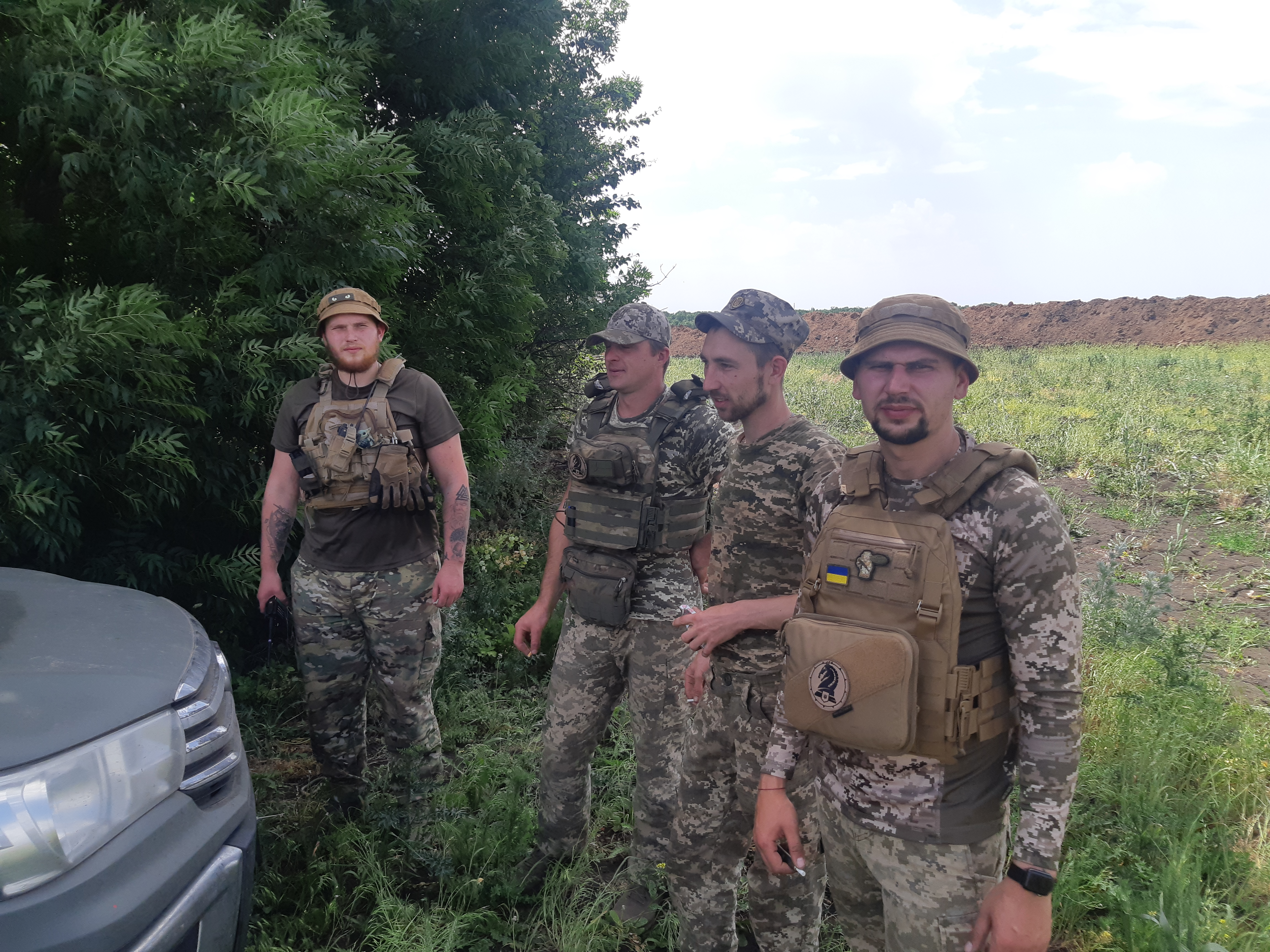
The main way to minimize the destructive consequences of this Western division lies in Ukraine itself — more specifically, along the frontline.
No meaningful geopolitical shift is possible unless Ukraine, with the support of its allies, physically stops the Russian advance.
The advance of the Russian army in the main sectors of the frontline is the one and only cornerstone of the “special military operation” as such and, arguably, of the Kremlin regime itself.
Extremely slow and costly advance still is an advance and gives Kremlin the reason to claim, that, despite all the setbacks, it still has the upper hand and “strategic initiative and advantage”. So, according to Kremlin, it is only a matter of time – however long it may be – that Ukraine will have to capitulate or will be captured and destroyed by the Russian military force.
That is an argument used by all Russian allies all over the world, including Europe and the US.
If Russia is deprived of this argument, if it is stopped on the frontline and is no longer able to move forward even by an inch, it is not merely a tactical thing or formality.
It would be a crushing defeat on the strategical level, meaning that the Russian aggression against Ukraine has failed, at least at this historical moment, that the former empire is no longer able to use its military power to forcefully subdue even its closest and most important former colony – a colony that has succeed to fend off the hundred-year long “motherland”, effectively defeating it.
That would be a geopolitical, military, symbolic, psychological defeat for Russia as a wannabe empire no less devastating than the fall of the Soviet Union. Actually, it would be another phase of the same historical process of Russia’s demise as an imperial state.
Of course, the exact part of the country where this frontline is halted – if it is indeed halted – matters as well. If it is still in Donetsk region, with last main cities remaining under Ukrainian control, it will be the most humiliating defeat for Moscow.
If it is in Dnipro or Kharkiv or both, with Kherson and Zaporyzhia thrown in, or even with Odessa and Ukraine cut off the Black sea: that would be a different story for the Russian regime, one it can pass on as a victory, but at the end of the day, there will be the bitter reality of the rest of Ukraine remaining out of its grasp.
Still, such goals already seem unreachable at least in the foreseeable and even more distant future, already creating a cause for humiliation of the Russian regime.
Right now the main dynamics of the war is evolving exactly around one question: is Ukraine already able to stop Russian advance along the frontlines and has it already started this process, with Russians admitting their failure, which will obviously take them at least half a year?
The Ukraine military and political leadership is claiming that it is turning or even has already turned the tide: first of all, by eliminating more Russian soldiers on the frontline than the regime is able to pour into the meat grinder.
There is also the new trend of high-precision deep Ukrainian strikes into the Russian territory, targeting and taking out its military and military-linked infrastructure.
Of course, such Ukrainian claims should be regarded with a big pinch of salt. But the very tendency is clear: the Russian military machine, although still destroying Ukraine and its infrastructure, is increasingly struggling to maintain the pace.
That is exactly why we already see the build-up of tensions inside the regime, which spill out even onto the public.
In a situation like this, the leadership of the dictatorship has basically two strategic options.
One is to seek some de-escalation and even ramp-off. The other one, double or triple down on escalation.
The question of which of the two the regime is more likely to pick is rather a rhetorical one.
And the absolutely obvious direction and form of escalation would be having the war and aggression spill over the borders of Ukraine and into the neighboring NATO countries or even further.
The scenarios of such a spillover could take shape both on the land and in the sea.
Moscow could opt for an aerial attack only, first of all by hitting the military and civilian infrastructure of the neighboring countries, which is used for aiding Ukraine.
But of course, a full-scale ground invasion must also be on the list. Swiftly grabbing a piece or several pieces of territory of a neighboring country or countries, digging in there and then turning it into bargaining chip under the threat of a nuclear response: that’s a pretty clear-cut option for the regime, despite the obvious risk of failure of such an invasion and a military defeat.
The main factor still holding the regime from launching such escalation most probably is the prospect of making a global deal with the current US administration not only on Ukraine, but also on Europe.
The risk of derailing such a deal with sudden military aggression in Europe might be the main reason why Russia has now scaled down the so-called hybrid aggression or provocations against neighboring countries.
On the other hand, Russia has challenged some Western European countries at sea, sending its warships to guard its so-called “shadow fleet” from capturing. This is an obvious move towards direct military confrontation, counting on the possibility that the West will step back. And it has; at least for now.
Another move – one that is currently being observed at the propaganda level – is throwing accusations at the Baltic countries that they have deliberately opened their airspace for Ukrainian drones to attack Russia. According to the leadership of the Russian regime, that means those states are allowing themselves to be drawn directly into the war and becoming “legitimate targets” for Russia.
This might be a purely informational operation aimed at sawing internal division in the Baltic states, giving “arguments” to those there who are urging to wind down bellicose policies towards Russia.
But it also might signal a possibility of Russian military strikes on those countries.
Direct military aggression towards Eastern NATO countries could be the ultimate “persuader” for Europe and for the US to accept Russian imperialistic ambitions and see the whole post-Soviet geopolitical space as its “hemisphere”.
One way or another, Russia is preparing for a full-scale war with Europe and in the historical perspective direct military confrontation between Russia and at least some of the European NATO and EU countries seems not only very likely, but actually inevitable.
The main question is the scale of this confrontation. Will it involve nuclear weapons and if yes, to what extent?
To be continued
The third and final part of Vytautas Bruveris's essay on WWIII will appear on Arch Frontline shortly.